Thursday, 16 October 2025

No 153 - Today's "Grapes of Wrath"


 For no particular reason, I recently picked up John Steinbeck’s classic novel, The Grapes of Wrath. It was first published in 1939, and I last read it maybe 40 years ago. Now, passage after passage leaps out at me as illuminating certain constants in American social dynamics that we can see repeating themselves today.


I experience afresh the gut-wrenching tale of an Oklahoma family, the Joads, escaping their Midwest dustbowl smallholding, not only because of the drought but because they are literally bulldozed out of their homes by massive, impersonal, uncaring corporations (sound familiar?). They become refugees: harassed, exploited and vilified at every turn as they try desperately to find work on Californian fruit-farms (sound familiar?). Yet the farms completely depend on such seasonal workers to operate at all. Meagre rewards beckon, but death and marginalisation are more often the ‘fruits’. And what is such a situation likely to yield, Steinbeck argues, but eventual wrath? In between yards of dialogue in ‘Okie’ argot, authorial interpolations constitute a coruscating critique of capitalistic practice at the frontiers of poverty. Plus ça change


Here are some choice passages (references are to my Pan edition).


. “And some of the [new] owner men were kind because they hated what they had to do, and some of them were angry because they hated to be cruel, and some of them were cold because they had long ago found that one could not be an owner unless one were cold. And all of them were caught in something larger than themselves. Some of them hated the mathematics that drove them, and some were afraid, and some worshipped the mathematics because it provided a refuge from thought and from feeling. If a bank or a finance company owned the land, the owner man said: The Bank – or the Company – needs – wants – insists – must have – as though the Bank or the Company were a monster, with thought and feeling, which had ensnared them.” [p.36]


Steinbeck is wise enough not to homogenise the oppressors, and the psychological insight is acute. The overall situation has only ramified: for ‘mathematics’ read AI; for ‘Company’ read Silicon Valley, or ‘the internet’, weaving nets we must all be affected by, trapped into using it, without fully understanding how any of it works.


. “The great owners, striking at the immediate thing, the widening government, the growing labour unity; striking at new taxes, at plans; not knowing these things are results, not causes … The causes lie deep and simply – the causes are a hunger in a stomach, multiplied a million times … hunger for joy and some security, multiplied a million times; muscles and mind aching to grow, to work, to create, multiplied a million times … If you who own the things people must have could understand this, you might preserve yourself.” [p.159-61]


In other words, Steinbeck anticipated, from radical inequality would arise only violence, a revolution, a civil war. As history has shown a hundred times over, and will certainly do so again: just multiply Steinbeck’s notional figures by a factor of 100. And if you don’t address the “oranges of the problem” (as the Tangerine Tosser put it recently), consequences are likely to be terrible.


. “… And with all the wars – God knows what price cotton will bring. Don’t they make explosives out of cotton? And uniforms? Get enough wars and cotton’ll hit the ceiling.” [p.37]


And who exactly is making money out of all the present warmongering (ask Francesca Albanese)?


. “Well, California’s a big state.

            It ain’t that big. The whole United States ain’t that big. … There ain’t room enough, for your kind an’ my kind, for rich and poor together in one country, for thieves and honest men. For hunger and fat. Whyn’t you go back where you come from?” [p.128]


There are the constants of American history: the classism, the othering and blanket denigration, the selfishness, the exclusion – even of white fellow-citizens. At other points in the novel, the immigrants are denigrated as animal, as a plague, as criminal, as pollution, as disease. Sound familiar? The ‘colour’ of today’s asylum-seekers may be different, racism more paramount, but the dynamic is eerily similar.

            The hopeful riposte is the hoary old American myth:


            “This is a free country. Fella can go where he wants.

            “That’s what you think! Ever hear of the border patrol on the California line? Police from Los Angeles – stopped you bastards – turned you back. Says, if you can’t buy no real estate we don’t want you. Says, got a driver’s licence? Let’s see it. Tore it up. Says you can’t come in without no driver’s licence.”


The borders may have shifted to the Rio Grande– or maybe there are no longer any borders – but attitudes repeat, and ICE’s methods, their disdain for documentation and bodily integrity alike, are not new. Nor was it new even in the Dustbowl years of the novel: one character is old enough to recall much the same treatment being inflicted on the Cherokee, iconic of the continent’s original inhabitants. "Land of the free" – sure, but only for some; giving the lie to the constant refrain by every party these days, that “the American people”, subscribing to “American values”, are somehow monolithic. Steinbeck shows there has never been such unity or agreement, however noble the ideal.


. “[W]hen I hear a business man talkin’ about service, I wonder who’s getting’ screwed. Fella in business got to lie an’ cheat, but he calls it somepin else. That’s what’s important. You go steal that tire an’ you’re a thief, but he [a salesman] tried to steal your four dollars for a busted tire. They call that sound business.” [p.129]


Time and again in the novel, the Joads encounter what Steinbeck suggests are fundamentals of capitalistic ‘business’: issuing false advertising, screwing the vulnerable if you can, buying a car for ten dollars and selling it for seventy-five, believing that mendacity is both necessary and acceptable. Anything different, independent or egalitarian (’socialist’ in current Republicans’ absurdly frightened characterisation), such as the so-called ‘Government Camp’ the Joads discover, is subjected to police harassment and violent raids by sponsored thugs. Sound familiar? As one character says: “I’m learning one thing good … If you’re in trouble or hurt or need – go to poor people.” Don’t bother knocking at Elon Musk’s door.


I could go on. If you haven’t done so before, do read The Grapes of Wrath. It’s long, and offers no hopeful solutions, but it’s profoundly humane, affecting and timeless.


Photo:Wiki.

Sunday, 6 April 2025

No.151 - Living poetry in Southern Africa 2 - Tools of stone


In this edition
I’m going to sort of pick up where I left off in Living Poetry No.1, where we looked at poetic treatments of some of our most ancient fossils. Which is to say, moving forward in prehistory, I’m going to focus this time on … Stone-Age tools. Move over, Fred Flintstone! 

It’s not unheard of, in this patch of the Eastern Cape, when ambling along a road or in the open veld, to unexpectedly chance upon a chunk of rock that has patently been fashioned by human hand – a Stone Age hand-axe or blade or core. It might be several hundred thousand years old, but will look as if it was dropped there yesterday. I remember my own interest was piqued by my once-upon-a-time head of department, Malvern van Wyk Smith, who had in his office a whole table covered with stone tools he’d found, tastefully and intriguingly arrayed
.
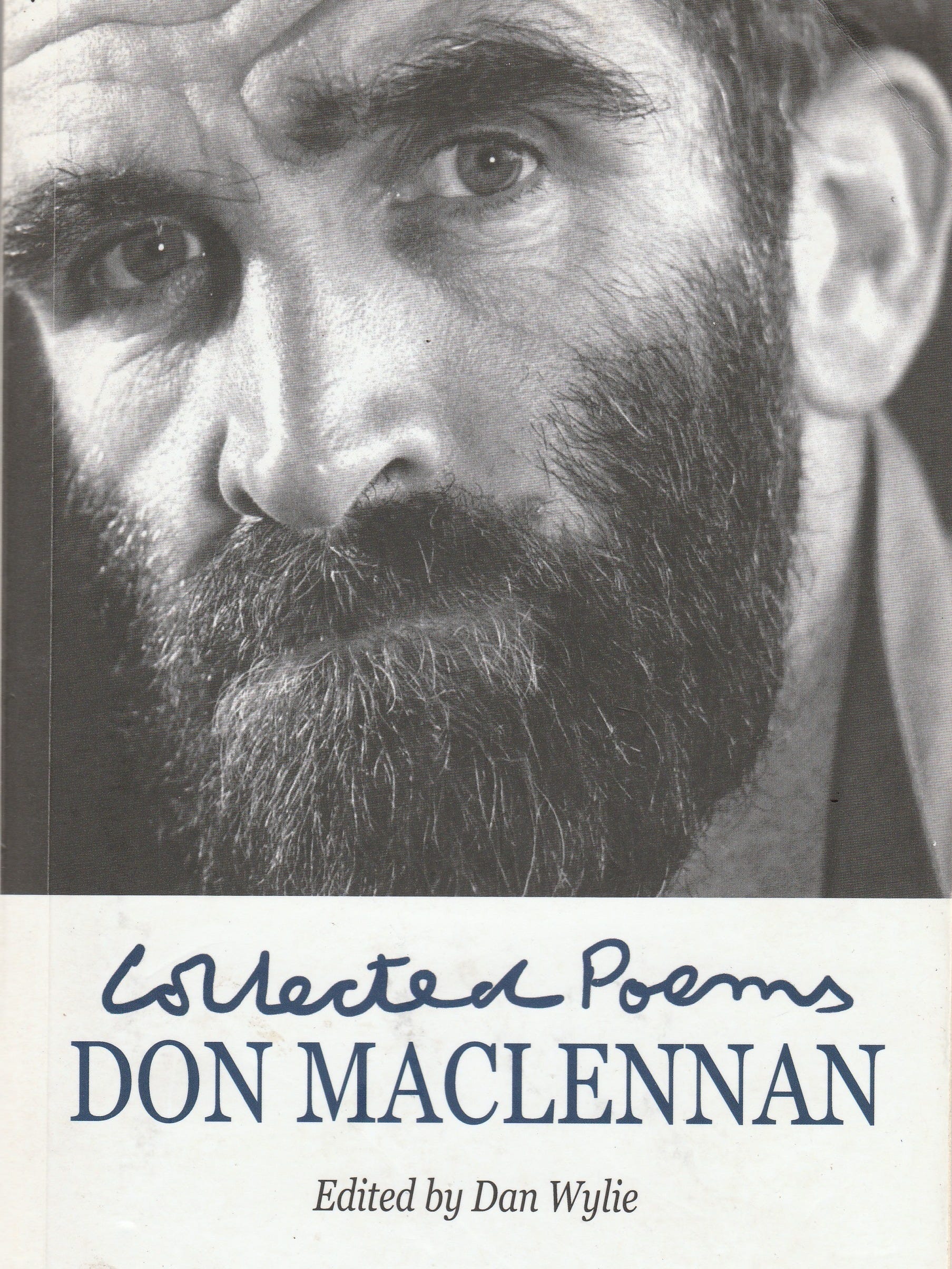
 Our colleague and poet Don Maclennan (I had more to say about him in the previous post) wrote in a poem entitled “Progress”: On the sandy verge across the road I found an ochre Stone Age core. … In this suburb, when you dig, you find history casually touching our makeshift edges, handaxes that obtrude like archetypes to challenge who we are after a million years of progress. As he did with the even more ancient prehistoric fossils, Maclennan uses the stone tools to throw our own civilisations into sharper focus. The sheer heft and compact solidity of a handaxe, surviving unaltered all this time, makes our present cultures, obsessed with speed and newness and tinselly possessions, seem “makeshift”, ephemeral. Handaxes feel to him like “archetypes” – that is to say, conceptions that flow through and create meaning across different civilisations and human psyches on deeper and more enduring levels than the everyday. In the poem “Iringa”, the poet, camping in a tool-strewn gully in East Africa, feels an almost mystical commonality with the ancient artificers: … hands like ours had held these perfect shapes and watched the talking stars around their own log fires. What did they call a handaxe in their tongue? It didn’t seem to matter that half a million years had passed: cold, grey, symmetrical, the axes were a language in themselves. (The Necessary Salt, 2006) 

 On the other hand, Maclennan felt that this commonality wasn’t necessarily a pretty one: the Acheulian handaxe might be “beautifully shaped”, but it was “No different really/ from the swords/ my father owned/ whose rust, I thought,/ was blood” (“Death Valley”). The apparently timeless and ineradicable nature of human violence calls into question the place and efficacy of art itself. And if there’s one major theme undergirding Maclennan’s work, it’s chewing on the role and value of art and poetry in the obdurate real world. 

Now there’s a strongly emerging school of thought that places the very first recognisably modern hominids – tool-makers – right here in the southern Cape. Scattered evidence points to hominid activity from at least a million years ago onwards. Fossilised footprints found near Nahoon Point, East London, have been dated to 200 000 years old. In the recesses of Blombos Cave, a few hundred kilometres along the coast from me, was found an ochre shard scored with perhaps humanity’s oldest known deliberate artwork, dated to some 77 000 years ago. Much closer, just three kilometres down the N2 highway, is Howieson’s Poort. There, dark overhangs nowadays challenge rock-climbers and also witness regular Xhosa propitiation rituals. But they once sheltered late Stone-Age people who, some 60,000 years ago, produced a wealth of more refined stone tools and pottery: a whole nexus known as the Howieson’s Poort culture. From this region, the argument runs, early hominids gradually dispersed north – probably more than once – eventually to populate the entire planet. Controversies rage, of course, partly because of the rare and scattered nature of hominid fossil remains. Central to our understanding has been the series of discoveries in the Gauteng province of South Africa, a thousand kilometres north of me. The area is now publicised as the “Cradle of Humankind”. There, in the Sterkfontein cave complex in the 1930s and ‘40s, Robert Broom identified important skeletal remains, including the skull of the famous “Mrs Ples”, later classified as Australopithecus africanus, some 2 ½ million years old. Debates swirled, as Brian Warner punned in his poem, “Dr Broom” (in Dinosaur’s End, 1996): 
From Colin MacCrae, Life Etched in Stone.


The antiquities selected were calm and collected
 And weathered the furious squall 
As Broom brushed aside – and thus intensified – 
 The palaeontological brawl. 

 In the wake of the publicity surrounding Mrs Ples, teacher and shy poet Ruth Miller (1919-1969), living in nearby Johannesburg, wrote her poem, “Sterkfontein”. If anything, the prospect of encountering, or at least learning about, our most ancient hominid ancestors, seems to her even more unpromising than for Maclennan. She expresses no excitement whatsoever about the archaeological discoveries – indeed she barely mentions them at all. The bulk of the poem is devoted to comparing the inner architecture of Sterkfontein to that of caves in India. “In India,” she blithely asserts, caves are “smooth”, make one “shiver”, and “go Boom!” Our caves, in contrast, “have teeth”, make one “stoop and crouch” and feel “lowly”. They are “scarred” with modern graffiti, and their echoes “say No to Yes”. Pretty crushing. We happen to know that Miller never once left the borders of South Africa, and the diction shows that her imagining of an Asian cave was actually, not without irony I’m sure, plundered from E M Forster’s novel, A Passage to India. Back in the labyrinth of Sterkfontein, when she does reach “a cavern strewn with ancient teeth”, the skulls are “dumb” – “and who would dare say less?” she rather enigmatically adds. Her final stanza is congruent with the existential darkness that infuses most of her poetry: it’s scintillating and deftly crafted but unforgivingly bleak: And when we reach the light – bare veld and boulder Hard as the hidden bones within the caves – Stand in the wind, that wind which, growing colder, Will blow us to the kingdom of shared graves. We all die, Miller says: end of story – or as the local saying has it, finish en klaar

For his part Chris Mann, in his poem “Sterkfontein Ancestor” (from Heartlands, 2002), rather agrees with Ruth Miller that “There’s little splendour in the sight of splintered bones” in the “oozing limestone of a cave”, but he still pretends to address Mrs Ples with familiar directness, and still desires to “stretch a hand// across three million years and touch your ruin”. Mrs Ples may be our genetic “Earth Madonna”, but Mann does wonder if we’ve improved as much as we’d like to think. In contrast, undeniably excited by Stone Age discoveries, is Cape Town poet and jeweller Michael Cope. A lovely exercise is to read, alongside one another, his volume of sonnets Ghaap (2005), and his wife Julia Martin’s ‘historical travelogue’, A Millimetre of Dust (2008). Both books respond to an exploration of the Ghaap Plateau in the Northern Cape, as well as to an area just north of Kimberley known as Canteen Kopje. Kimberley, of course, was the site of the 1870s diamond rush, leaving the infamous “Big Hole”, now a tourist attraction. Martin writes: 

After the diamond diggers at Canteen Kopje came the archaeologists, digging, sorting, labelling, counting. Picnicking now beside the vandalised information boards of the outdoor exhibit, we read that the site is a Stone Age treasure trove, with maybe a hundred million artefacts […] enough specimens to fill a museum to overflowing, but even to build it of them also. […] And then I see. A few are strangely sharp and unweathered, but many of the big worked rocks are now so old and worn they are beginning to look like natural objects again. [They] are thought to be a million years old and more. (100-3) 

In the poem titled “Canteen Kopje”, Michael Cope also mentions the unthinking ransacking of the area by diamond seekers who “mined the hill into despair” – but after the “gleaming gems and whiskered fools/ are gone; the tools remain, again”. Like Maclennan, Cope can’t help comparing the solidity and antiquity of those tools with the tawdry fragility of our modern implements – “knives, forks, bowls/ stainless and formica”, and aircon units rattling in the dark. (And I suspect that Cope chose the time-honoured sonnet form – compact but complex, explicitly crafted yet versatile – precisely to echo the quality of a handaxe.) Unfortunately, inevitably, these artefacts are stubbornly silent about their makers and practitioners, about whom we know almost nothing except that they made these tools. “Nobody Knows” is the title and refrain in another poem in Ghaap. The silence is total, no matter how we might fondly and poetically imagine that the handaxes we fondle have a “language of their own” (Maclennan) or that we might hear “with the ear of the hand” (Cope): 

The tools are the thoughts of ancestors 
who should be called into the convocations of the wise, 
but they are still and patient, and their voices 
cannot reach through our walls – they do not rattle in the dark.
(“Tools”) 

 I can attest to how strangely moving it is to hold in one’s living palm a hefty handaxe, knowing that another hand much like my own must have wielded it with purpose a million years ago. But we are still left with a fundamental question: How, in the end, are we to think of and understand our relations to these peoples who are the progenitors of all of us? All of us.


 *****

Monday, 31 March 2025

No. 150 - Living Poetry in Southern Africa 1: Ancient fossils

The Waterloo Farm cutting © Dan Wylie

 Living poetry in Southern Africa 1

The aim of this “Living Poetry” series is simple: to have some fun exploring various aspects of Southern African life and history through its wonderfully rich traditions and strands of poetry. Poetry lives, I want to suggest, has always been and remains a living tradition, reveals lives and feelings and ideas in ways no other medium does. (So “Living poetry”: multiple puns – get it?)

My themes I anticipate will be entirely whimsical, with no pretence to a predetermined sequence, to comprehensiveness, or to coverage of academically fashionable issues. Each post will be more or less free-standing, so you can read or listen to them in any order. I’m hoping, in a fairly casual and accessible way, to entertain and inform even readers who might not ordinarily spend much time with poems, let alone poetry from the southern tip of sunniest Africa.

I’ve said ‘Southern Africa’ because, although I’ll concentrate on South Africa, the country I live in now, I anticipate straying into neighbouring countries too, especially Zimbabwe, where I was born and raised. We’ll see where my fancies take me.

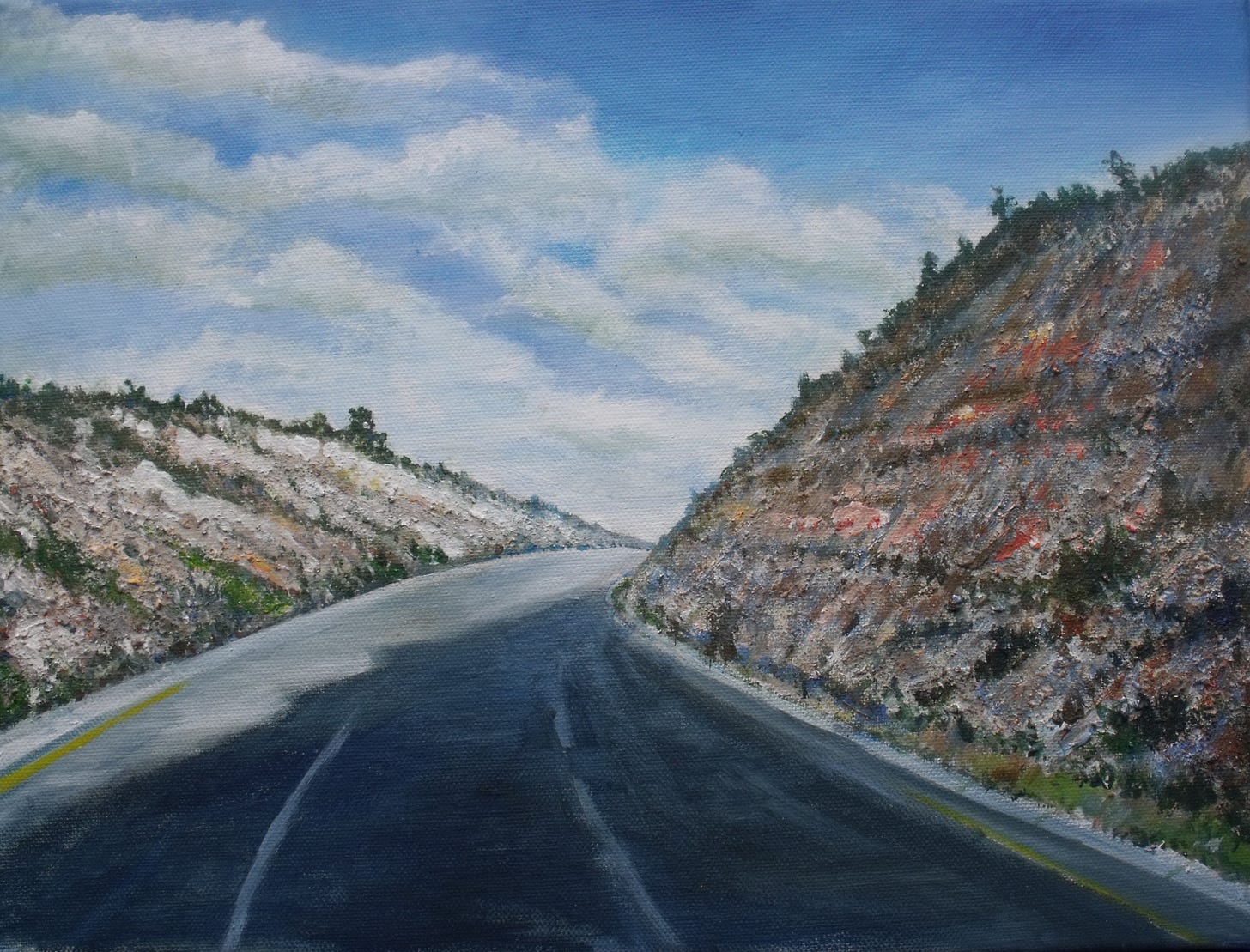
For this first one, though, I want to go right back to the very beginnings of time. And also to begin with where I am. I’ll start whimsically with … road cuttings. I live near a small university town in the Eastern Cape, known successively through history as Graham’s Town, Grahamstown, and most recently Makhanda. Back in the 1980s, for rather dubious political reasons, the government re-directed the N2 highway round the southern fringe of the town, slicing deeply through a number of inconvenient ridges in the process.

Cutting © Dan Wylie

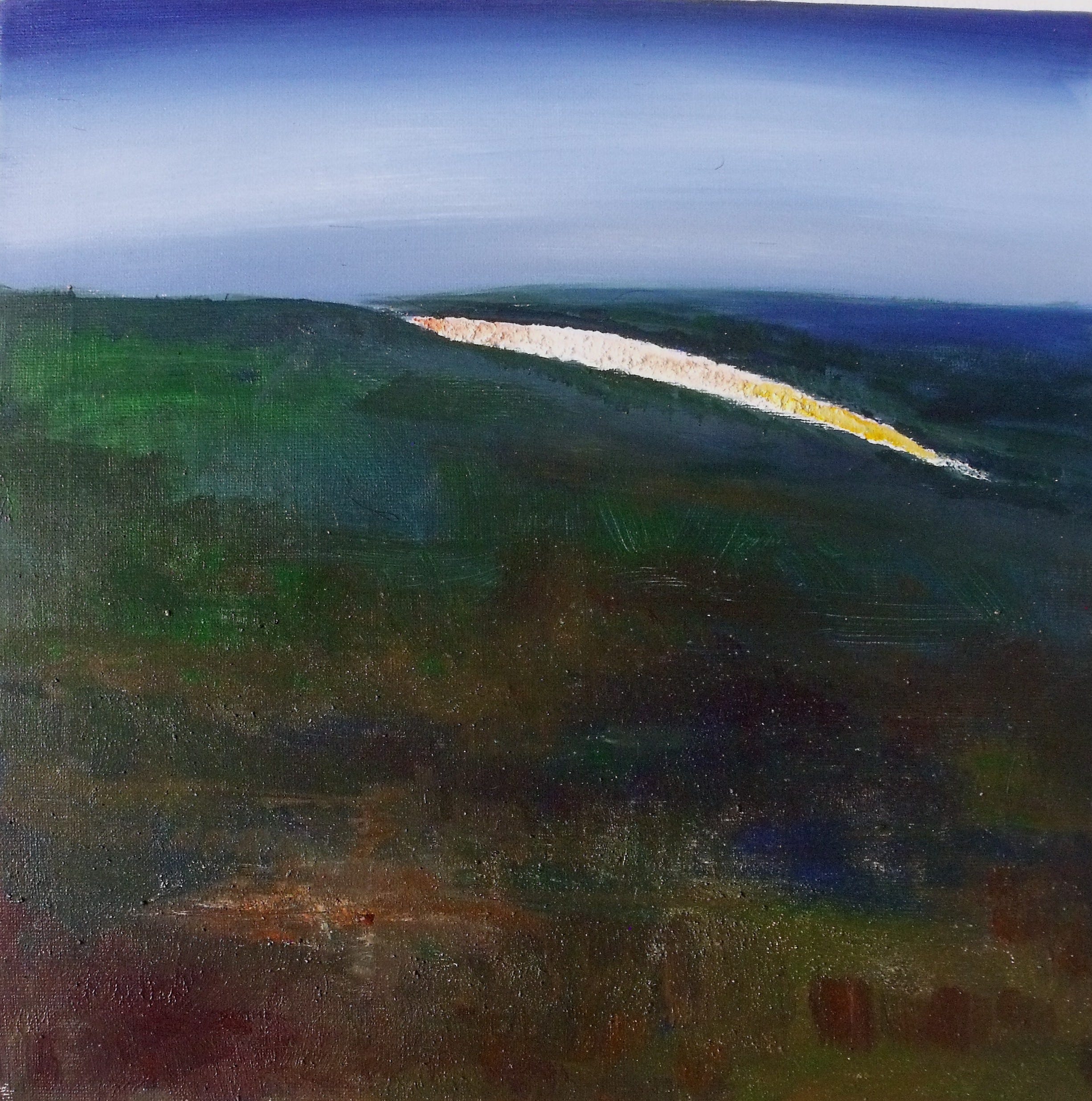
Artistically, I found these cuttings irresistible: chalky curvaceous shapes, aesthetically clean and shapely, but also painfully blade-like wounds in the green landscape. More importantly, the cuttings just incidentally exposed layer upon layer of sedimentary sandstones and shales. This whole region, when it was still part of Gondwanaland and was positioned much closer to the south pole, was once awash under turbulent seas and estuarine backwaters. Over millions of years, the sediments were deposited, compressing, hardening, entombing all manner of the earliest plants and creatures to inhabit the planet. These seafloor sediments were then disrupted by volcanic and tectonic upheavals, in places tilting them into crazed and slidey angles.

You can see this at the Waterloo Farm cutting, which I drive past on my way to town. At this section in particular palaeontologists, notably Dr Rob Gess, have for some years been unearthing – or un-shaling – a most extraordinary range of fossils. Many of them were previously unknown to science; their discovery is revolutionising global understandings of primordial eras, notably the Devonian period, around 400 million years ago. There are scorpions and lampreys, gymnosperms and charaphytes, and lobe-finned all-but-walking fish which, Gess argues, are our very earliest known direct ancestors.

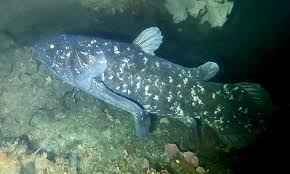
Among the fossils Gess found is a baby coelacanth – a species of armoured fish which to this day, virtually unchanged, still swims at great depths in the Mozambique Channel and off the Comores. So improbably persistent is this fantastic survivor, and so marvellously ugly, that it has attracted mention by a number of poets. Douglas Livingstone (1932-1996) is one. In his poem “Address to a Patrician at Station 8” (from his 1991 collection A Littoral Zone), Livingstone precisely captures “Bwana” Coelacanth’s quirky and “pea-brained” but “regal” air, with its “jointed cranium” and “grim profile of a misanthrope”. As a marine biologist, Livingstone had no qualms acknowledging “Old Four-Legs” – as the coelacanth became fondly known – as one of humanity’s most ancient evolutionary ancestors, or at least “cousin”. So Livingstone’s poem celebrates the intricately entwined genealogies of all life-forms, all deserving the respect we give to family.

Albany Natural History Museum, Makhanda
Coelacanth, WikiCommons

At least two poets resident in Grahamstown responded to the fascination with fossils, even before Gess’s revelations. In “Orthosuchus”, the late Chris Mann describes chiselling out of scrub and rock the bones of a croc-like creature. Its shapes gradually emerge, like the sculpture of Atlas emerging from its matrix of marble, left thus unfinished by Michelangelo. Mann ends the poem:

… I saw it then. A few billion years

since life first stirred on this rock,

you, that impassioned Atlas and I

are still trying to drag our heads

out of a lump of primordial stone.

We may think we’re wonderfully evolved, Mann implies, but we still leave an awful lot to be desired

.

Similar thoughts occurred to Don Maclennan (1929-2009), who then lived diagonally across the street from Chris Mann. Maclennan was one of my undergrad lecturers at the town’s Rhodes University; I later became a lecturer myself in the same department, and Don became a supportive colleague, deep friend, and rock-climbing partner. Embedded, as it were, in his voluminous output of wry and lapidary poetry, are many references to the fossil histories that precede and underpin all our existences.

One poem is titled “Sandstone Pavement”. Maclennan was very conscious that the ground we walk on here “was once/ a seabed,/ had its origin/ in tons of silt/ the gravitation/ of the dead …” That word “gravitation” – much better than mere ‘gravity’ – so weightily conveys the deep process of settling and petrification of fossil remains.

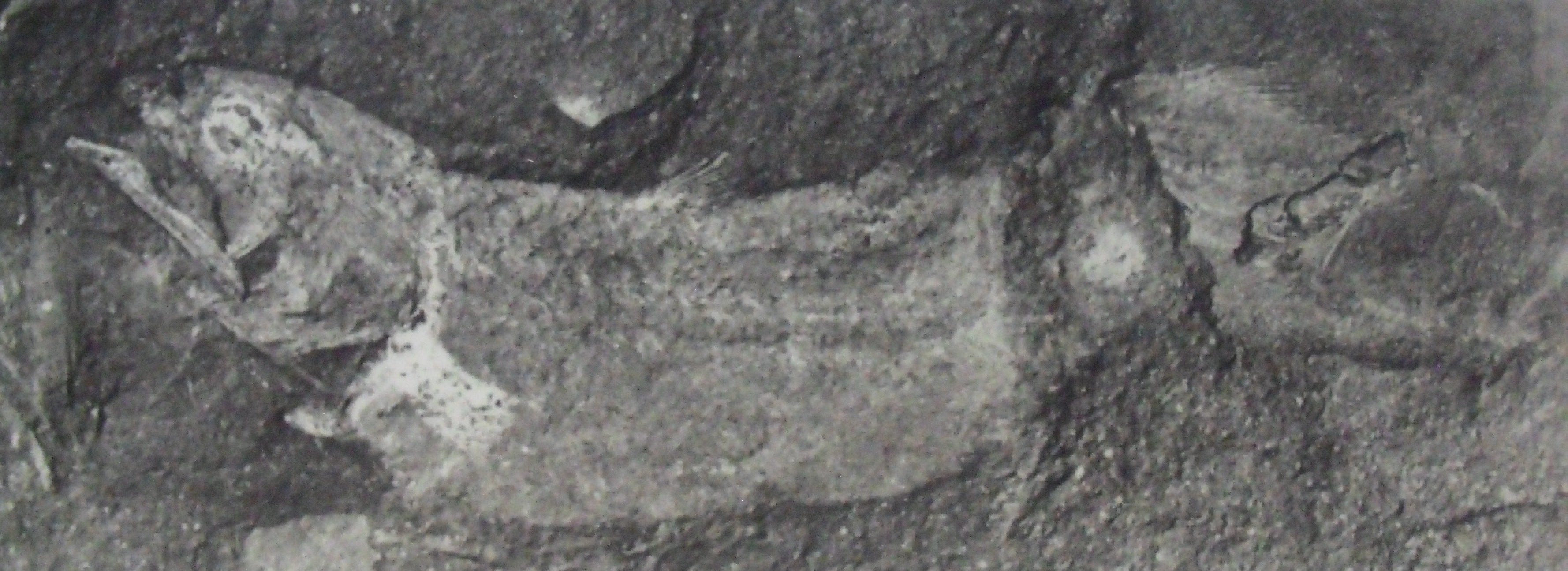
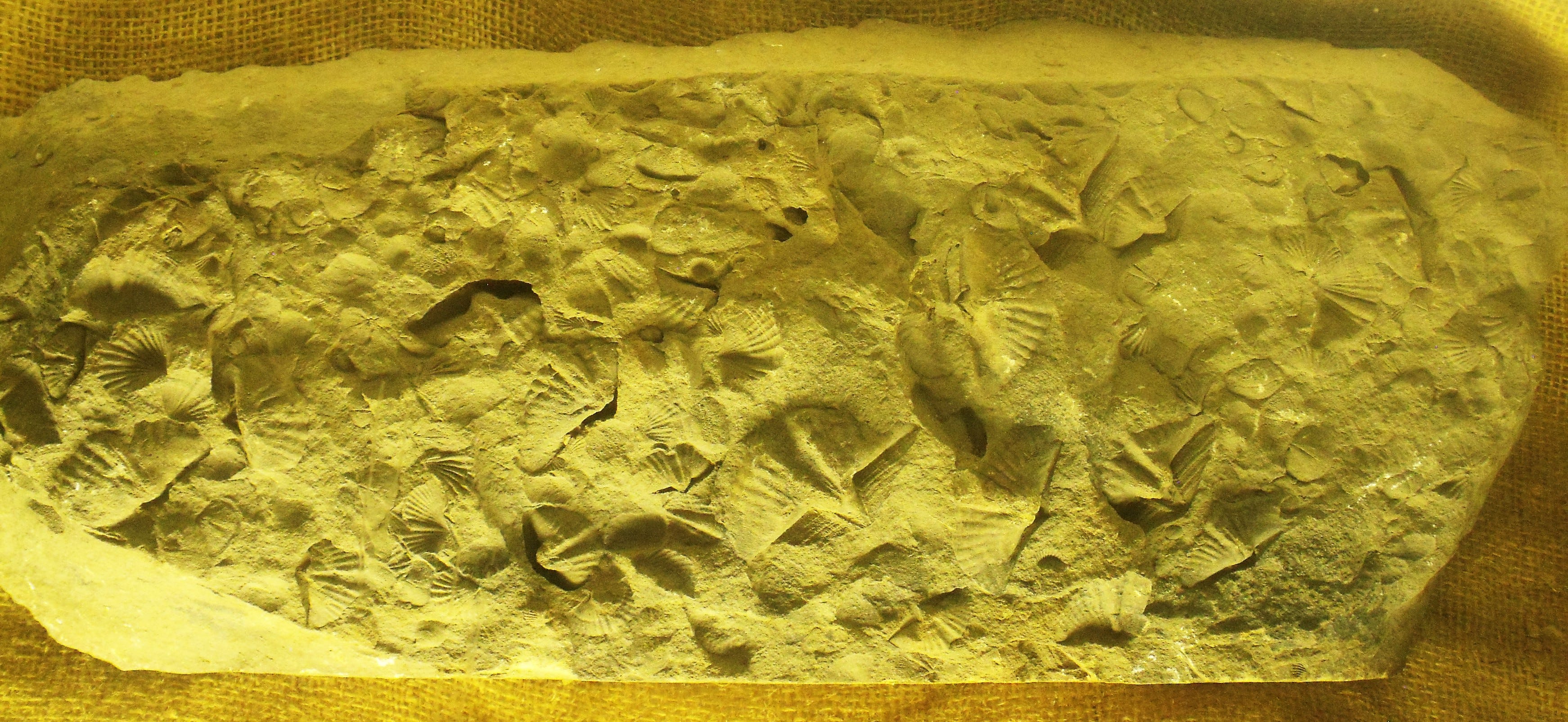
And in a cabinet in Grahamstown’s Albany Natural History Museum, he could connect visually and viscerally with those signs of our primordial past. The following short poem appears in his 2004 collection Excavations:

In the town museum
a ten inch slab of seabed
on display reveals
hundreds of small creatures
crushed into each other
in a mass grave,
teeth biting into flesh and bone,
a deadly carnival turned to stone.
The very slab, still in the Albany Natural History Museum.

The poem makes no further comment on what this might mean, but it’s clearly a depiction of a Darwinian broil of predation and conflict. Grim stuff, not to be romanticised just because it’s prehistoric. I suspect it had more to do with Maclennan’s state of mind at the time than with the actualities of crustacean relations!

In a rather enigmatic story entitled A Brief History of Madness in the Eastern Cape (2001), Maclennan describes this same slab. He lightly fictionalises his own initial arrival in Grahamstown (which he calls Georgetown).

It was raining the day Mavis and I arrived in Georgetown. So we went to the museum. We whispered along the corridors of exhibits, the dumb past all entombed and labelled. There was one in particular – a piece of Mesozoic fossil beach. … It is a chunk of fossil life, with thousands of different shapes and sizes of crustaceans packed into each other, eating and being eaten, like a Notre Dame gargoyle, foot in mouth, shell overlapping shell, and endlessly impacted palimpsests.

Then there was also a collection of Settler culture – not so tightly packed as the fossil, but clearly in the making. Individual life agonies imprinted on these derelict possessions – spectacles, baby bows, bridal nighties, fading intimate diaries. Each one posed a question for the future.

He’s referring here to the British settlers and military who violently evicted the resident amaXhosa people in the 1820s, for a time under the leadership of Colonel John Graham himself. There’s a related example in the Excavations collection, which in fact centres mostly on the excavation of a typical British frontier fort. There, archaeologists fossick through the nineteenth-century rubbish-tip, finding a parallel palimpsest of “broken bottles, buttons, bullets,/ coins with the head of George V, pottery fragments,/ … clay tobacco pipes, and bits/ of rusted iron.” From this, as with the fossils, the scholars try to “reconstruct a way of life.”

Typically of his vivid but slightly elusive manner – drawing us in but also allowing us to draw our own implications – Maclennan leaves that “question for the future” itself unstated. But it seems fairly clear that he is posing the possibility – probability, really – that our historical bric-a-brac will also become fossils of a sort, another palimpsest for future archaeologists or even palaeontologists – or Martians – to puzzle through.

But beneath that, further dark and existential questions lurk. Are the Settlers (and by extension ourselves in the present) at bottom just another manifestation of that Mesozoic brawl of mutual violence? What makes us modern humans any different from those cannibalistic crustaceans? Are we not also destined for extinction in the unthinkably long unfolding of geological time? If so, why are we here at all? Can our art, our language and our poetry, unique to us though they be, really somehow redeem us?

Don Maclennan had many, profound if always provisional insights about all this, and not all quite so forbidding. But, as do his brief but beautiful, searching and self-deprecating poems, I’ll leave you to grope towards your own conclusions, if you dare.

We have lots more ‘palaeontological poetry’, but that’s enough from this old fossil, for now.

*****