Thursday, 24 November 2022

Blog 131 - Baptiste Morizot's "Ways of Being Alive"


The French philosophers I’ve routinely encountered in literary studies – to wit, Maurice Merleau-Ponty, Jacques Derrida, Michel Foucault, Deleuze and Guattari – have oscillated between the dizzyingly stimulating and the infuriatingly unintelligible. In the emergent thread within ecological-literary academe dubbed Critical Animal Studies, Derrida’s essay “The Animal that Therefore I Am (and more to follow)” has assumed a prominent space. In between quite lucid and polemical statements (like condemning the conceptual divide between ‘human’ and ‘animal’ as a “crime”), he can be bafflingly elusive, addicted to endlessly involuted puns. Mostly the essay convinces me that Derrida didn’t understand cats. Likewise, I attempted at times to apply Deleuze and Guattari’s fashionable concept of “becoming-animal”, frankly without feeling I fully understood what they (or I) were doing. But then I’ve always been a rubbish philosopher/theorist. I respond rather to their poetics, their intriguing metaphorical ventures, their colourful word-play – precisely what, in the eyes of some of my academic colleagues, disqualifies them from being philosophers at all.

Baptiste Morizot – though he refers glancingly to all these predecessors in his book Ways of Being Alive (Polity Press) – is, thankfully, eminently lucid. Of a younger generation (he is 40-ish), he is a lecturer in philosophy at the University of Aix-en-Marseille. He has several other books to his name, which I’ve not yet read, but which are evidently related in theme to Ways of Being Alive. This title, though a fair translation of the original French Manières d’être vivant, sounds unhappily a bit like a popular self-help manual. Though it is concerned with trying to outline a way of living better – that is, in more fruitful conjunction with the non-human fellow-denizens of our world – it is much more than a set of rules to live by. It is too nuanced and complex, too ambiguous, too lyrical for that.

It seems there’s something of a trend towards, not quite denying “red-in-tooth-and-claw” Darwinism in our conceptualisation of nature, but counter-balancing that view by focussing on mutualisms, symbioses, collaborations. One branch of this trend is concerned to blur if not altogether disburse the putative division between ourselves and other creatures. Most of the skills and abilities we usually boast of as uniquely human are, it turns out, shared by many other animals, from gorillas to ants; we are far closer to one another than we are different. Moreover, we are scarcely divisible from the environment we so gaily swashbuckle through as if we own it. After all, each one of us is mostly water (Morizot has a charming chapter suggesting that we still pass on and carry saline elements of the ancient seas in which once lived our most distant ancestors – sponges.) A leading light in this field, Donna Haraway, likes to point out that of all the cells that astonishingly combine to form a person, only about 10% contain human DNA: the rest is microbial, bacterial, viral – non-human elements all busy constructing and combining and repurposing one another through “horizontal gene transfer” (elaborated in David Quammen’s rather annoyingly chatty book, The Tangled Tree). On this view, the human “self” is something of an illusion, a useful fiction that has unfortunately run amok on the planet. Similarly, there is no clear line between “culture” and “nature”: “nature” is not “out there”, a mere resource void of intrinsic meaning – the stance that has permitted us to exploit and wreck the biosphere so shamelessly. Rather, “nature” is within us, too. Hence Haraway writes instead of “natureculture”; others of “biohumanism”, or “posthumanism”. Haraway contributes to a wonderful collection of essays edited by Anna Tsing entitled (echoing Morizot), Arts of Living on a Damaged Planet, which ranges from microbes to lichens, ants to salmon and (again echoing Morizot) wolves.

A related trend is also emerging: the fantastic symbiotic relationships amongst plants (without whose presence, incidentally, we would simply cease to exist – would never have existed). A slew of new books includes Merlin Sheldrake’s delightful Entangled Life (about fungi), Peter Wohlleben’s The Hidden Life of Trees, and, pre-eminently, Richard Powers’ astounding novel about humans and their trees, The Overstory. So it’s perhaps not surprising to find Powers contributing a Foreword to Ways of Being Alive. Of Morizot’s work Powers writes:

The view from the heights of this book is vertiginous and exhilarating. Morizot explores life at all gauges, from the cell to the entire biosphere. He peers through the longest lens of time, backwards across billions of years and forwards into an endlessly unfolding future. His words reawaken consciousness to all its possibilities. For Morizot, “the best analogy for understanding the evolutionary nature of the biosphere is that of a poetic fire: a creative fire”.

For some, that might smack too much of a wannabe spirituality, of discredited gods, or a primum mobile, or ether, or a Herbert Spencer-like Creative Principle. But it’s an analogy, not a statement of religious fact. Though Morizot does entertain certain refurbished notions of animism (again, he is far from alone in this), and though he wants in a sense to re-sacralise our relations with the biosphere, he is not trying to entrench a pre-determining dogma. It is impossible, he says in an endnote, to altogether evade metaphor and analogy, even in the sciences (our own scientist-poet Douglas Livingstone knew this). Rather, the writer-philosopher participates in the enigmatic creative forces of the biosphere by being poetic, by applying the surprising recombinations and penetrative engagement of poetry in the very attentiveness of language. Morizot’s own rich lyricism enacts, beyond either logic or earthy pragmatics, a search for a “complete style of attention”. John Felstiner, in his book Can Poetry Save the Earth?, calls it “poetry’s exact enlivening touch for nature’s common surprises.”

Not that either philosophical logic or worldly practicality is missing from Ways of Being Alive. Morizot supports his arguments with references to a wide range of philosophers, from Kant to Nietzsche, Dewey to Rawls, Spinoza to Latour. On the other count, his perspectives are deeply informed by in-the-field, tramping-through-the-snow work, tracking wolves through the mountains of central France. The reintroduction of wolves here is one of those small-scale success stories of “rewilding”, to use the favourite term of George Monbiot (another compatible, if more sociological, thinker-writer). Having been raised alongside many wild animals by my naturalist mother, this is the most fascinating aspect of the book for me. And particularly intriguing is an episode of communicating with certain wolves by mimicking their howls. And they reply! Or do they? What could be going through a wolf’s mind at that moment? We can’t know exactly, of course, but something is going on. As my mother demonstrated a thousand times, communication between species happens, can be nurtured and invented. It is a hint that animals can be “intercessors” between us and the world, a kind of doorway to recognise our still deeper “affiliations to plants and bacteria, which lie further back in our common genealogy”. They are like “ferrymen or smugglers”, connecting us in mutual respect, however mysteriously. They embody a sensory connection lost to too many urbanised moderns, the product in large part of “a dualist philosophical anthropology, which runs from Judeo-Christianity to Freudianism … the hierarchical dualism that contrasts humans with animals”. Indeed, many of us don’t even recognise that we’re desperate for deeper connectivity, one which nevertheless respects the difference of the Other. Morizot uses the task of tracking of the wolves through the forests as an example (I’m reminded a little of Louis Liebenberg’s work in The Art of Tracking: The origins of science). Here’s a particularly arresting passage, exemplifying a “human openness to the outside”:

To deploy together all the vibrating antennae of sensation, perception, interpretation, deduction, intuition, imagination. We need the incandescent alloy of a vibratory sensitivity to others in their otherness, a participant perception, an interpretive and imaginative activity of great boldness and caution, a rigorous and wild activity of deduction, a creation of hypotheses that is dishevelled in its heuristics and perfectly reasonable in its conclusions, a general openness to signs, an investigative use of the sensing and walking human body … We can try, although we often get it wrong, to translate [their wealth of meanings] a bit.

Wonderful, and suitably humble. And it’s now almost axiomatic that there are tangible ecological benefits to the reintroduction of an apex predator. Morizot (like Monbiot in his book Feral) cites the oft-aired case of wolves being returned to Yellowstone Park in the US, with dramatic impacts on the whole ecology. (I did once talk to a Finnish wolf-researcher, mind you, who judged the original assessment of that impact “a bit premature”. It would also incidentally be fascinating to compare Morizot’s book with Mark Rowlands’ The Philosopher and the Wolf and Barry Lopez’s Arctic Dreams.) In any event, as with the reinvigoration of bison populations in Poland, bears in Greece, wild boar in Italy, human-interface problems can accrue. We’re all too familiar with this sort of thing in southern Africa, with jackals in Karoo sheep country and leopards in the Western Cape, not to mention elephants in Botswana. One of the outfits Morizot works with is called CanOvis – dog/sheep – who try to intercede, work out liveable solutions, that can benefit both wolves and the sheep-farmers on whose flocks the canines inevitably prey.

The French wolf situation is in effect a case-study, a real-world synecdoche, for a global crisis. The dynamic of human domination – with firearms, gin-traps, poisons, axes, ploughs, fences – by way of protecting crops and livestock, has everywhere resulted in catastrophic declines in the populations of almost all classes of other worldly inhabitants. What we do with, and say about, other animals (and plants and insects, fish and fungi) has to be evaluated against the fact that today, Morizot laments, “we are creating from scratch a mute and absurd cosmos which is very uncomfortable to live in, on an existential, individual and collective scale. … [W]e are generating global warming and a biodiversity crisis that concretely threaten Earth’s capacity to provide human beings with habitable conditions.” Not only potentially uninhabitable for us; the catastrophe means that an infinitely variable and unpredictable gamut of evolutionary possibility has been snuffed out.

I’ve mentioned in passing a bunch of other related books partly to emphasise that Morizot is increasingly not alone in his broad thinking. This might also make him seem a bit less than entirely original. After all, as early as 1798 William Blake was lamenting that some people saw a tree as merely “a green thing that stands in the way” instead of a flourishing world of delight. Prophets and scholars of anthropogenic environmental meltdown have scarcely been lacking over the last century– thousands of them, from Thoreau to Naomi Klein, Rachel Carson to Greta Thunberg, Aldo Leopold to Bill McKibben – culminating in terrifying books such as James Hansen’s Storms of my Grandfathers and David Wallace-Wells’ The Uninhabitable Earth. Compared to the latter rather swingeing compilation of alarming statistics, Ways of Being Alive is infinitely more subtle and sensually engaged. If the underlying message is similar, it is nevertheless one that needs to be said again – and again and again. Morizot does so with unusual density, complexity and beauty. He is, novelist Alain Damasio writes in an Afterword to the book, a bit of a “mongrel”, a “failed novelist” who forges a peculiarly elegant prose from philosophical ideas, enriched by his living those ideas through in pawprints and scats.

Is there a way out or through, in Morizot’s vision? One route, as I mentioned earlier, is an appeal to the values suffusing ancient animism. This is not to recommend an impossible return to some atavistic primitivism, rather something newly invented to suit our times. But the values remain pertinent, “namely complex social relations of reciprocity, exchange and predation which are not peace-loving or pacific … but are political in a still enigmatic sense, and call for forms of pacification and conciliation, of mutualist and considerate cohabitation.” Interestingly, Morizot evokes our familiar African concept of ubuntu as an analogy. To achieve this, we each need to become “diplomats of interdependence”, the “guardians” of a “community of interdependencies”. In this diplomatic mode, the fossilised shibboleths and stereotypes are left behind for a kind of space of creative ambiguity. A capacity to entertain mysteriousness itself seems paradoxically key. In Morizot’s wolf work, the more he learns and hears from all sides, through tracking, howling, thermal imaging at night, swapping anecdotes with shepherds, the more exceptions, enigmas, ambiguities emerge:

Dogs, wolves, sheep, the shapes merge into one metamorphic dialogue: you are my ancestor against whom I fight; you are my old prey that I defend at the risk of my own life; I am your descendant who sometimes plays with you, and whom I kill when you get close to my protégés who were still my booty only yesterday; I am your ancestor, who desires you and deceives you.

As this might indicate, “becoming-diplomat” means discarding the hard lines we so often and instinctively draw between Them and Us. It means recognising that each discerned entity is in fact many identities and impulses woven together. There are many "ways of being alive". Each contact, each situation, each meeting requires an open attentiveness that will allow for an individuated and appropriate response. (This is, I would say, rather Zen.) There’s an underpinning of necessary idealism in this strategy, but Morizot is not naïve about it. It makes negotiation harder, not easier, but also ever more vital. (He likes Donna Haraway’s felicitous phrase, “staying with the trouble”.) He knows all too well that his notion of “adjusted consideration” towards animals, rivers, forests is regarded by “the men in suits who rule the world” – the executives of global Petro-government who signally failed last week to achieve anything of life-saving substance at COP27 – as childish and irrational tosh. Let’s face it, profit-driven neoliberals are unlikely to be persuaded by this kind of thinking. But we have to try. In his Epilogue, which manages to be simultaneously grim and ebullient, Morizot concludes:

Why should we treat the living world with consideration? Well, because it is this world that made our bodies and our minds, capable of emotions, joy, meaning. It is the living world that sculpted all our faculties, including the most emancipatory, in a constitutive interweaving with other life forms. It is the living world that keeps us upright in the face of death, by its continuous and joyful infusion of life (this is called, among other things, “breathing”). Unplug this connection to the living world, and it’s all over.

*****

Sunday, 6 November 2022

Blog No 130 - "Thicket": Harry Owen's new poems


For the information of imperfectly-educated readers, Harry Owen is an immigrant to South Africa from darkest England, erstwhile Poet Laureate of Cheshire, and quite likely the most genial promoter of poetry south of Seamus Heaney. Entering the so-called sunset years has not prevented him forging a second marriage, lodging in Grahamstown/Makhanda, and falling deeply in love with the thorny and shaggy wildness of the Eastern Cape. He has published several volumes of fine and affecting poetry, both his own (notably Non-Dog, The Cull and All Weathers) and anthologies of others’ (For Rhino in a Shrinking World and Poems of the Grahamstown Diaspora). As one of his many ventures to insert poetry into everyone’s lives, he ran for several years a monthly poetry-reading evening, dubbed Reddits. A wonderful free-for-all space in which greying locals recited Robbie Burns alongside township rappers, established poets intoned alongside students trying out. Somehow Harry would keep things under control, with always just the right word of encouragement, solemnity or jokiness.

Sadly for us, Harry and his wife have emigrated to another country – that is, Stellenbosch – a “land of plastic grass/ and birdlessness”. This has been a serious emotional wrench for him, as several poems in this new volume, Thicket, attest. Reddits readings continue, but they’re not quite the same. Come back, Harry, all is forgiven! In fact, he was back recently, to launch this collection, coinciding with a whole “Thicket Festival” happening in nearby Bathurst. The Eastern Cape’s Albany Thicket is not just a generic term: it has become a scientifically-recognised biome in its own right, with its own unique assemblage of biodiversity, of endemic species of bird and tree, mouse and mole. Harry Owen’s loving observations of the region’s landscapes, flora and fauna, and especially of birds, forms the core of this collection. Individual poems focus on the cicada, cobras, bougainvillea, a mantis, even a moth called the Cycad looper.

The richness is perhaps best summed up in “Amakhala Venn” (Amakhala being a nearby game reserve with which Harry formed a special bond). There, startling colours clash and overlap, as in a Venn diagram, and one gains hints of “the way the world once was, the way it yearns to be.” This is ‘Nature’. the matriarch, “mama, mother”, a world of “watchful calm” in which “the guileless impulse of animals” offers a stance less torturous than the human.

But Harry does not succumb to a vacuous Romanticism. Whatever soul-food quiet nature might provide, it doesn’t come cheaply or unalloyed: Harry acknowledges the existence of the electrified fence; and “how would we feel/ without it? Be honest now.” The thickets may be where snakes cavort and mate in wild independence, but it is also subject to hardship, as in the poem “Drought”, and it’s full of spines one has to grasp. Not an easy world. That call for honesty is another persistent feature of Harry’s life-view, and it goes along with his accessibility; there is no modernist or postmodernist trickery here, no portentous obscurity.

One can feel a little more at ease in one’s garden, perhaps. A number of these poems are set in or derived from, the Owens’ property in Makhanda, happily endowed with some shadowing trees rich with life. One can glean some sense of ease here, as in the poem “Sapiens”:

Dusk is drifting in and the air feels

autumnal, chilled, as now you stand,

peeing, under a sneezewood tree

in the garden where a black-headed

oriole joins you in joyful retreat.

Two dogs play, “wise beyond words”. But even here unease intrudes. For example, in “Scraping the Leaves” Harry, mid-contemplation, compares us humans to an olive thrush scratching frenetically through a leaf-pile:

Are we so very different? All through life

we scatter someone else’s stale debris

around us, hurling dry twigs to the air.

We flail to survive, and habit’s the long-

established way of doing it. But fed,

safe, watered – must we still insist on scraping?

These destructive habits, which we dignify or excuse as “normality”, may be just “that damaged smear of life we’ve become accustomed to”, like a smoker’s hack, “wasting us all away.”  Quite a few poems have an air of elegiac mourning for non-human lives lost, and sometimes an edge of rancour at human-induced damage. Moreover, Mother Nature is liable to get her own back, not least likely via plagues such as Covid-19. Harry echoes the great eco-poet Douglas Livingstone in “La Corona”: “The earth comes fighting back, and who can blame her?” He is not as misanthropic or vengeful as some, mostly feeling just “a deep sadness, regret. Frustration.” Few if any South African poets since Livingstone are writing with such ecologically-informed accuracy and engagement, even activism (his edited collection For Rhino in a Shrinking World is just an extension of in-the-field engagement with famous wildlife vet William Fowlds). ‘Nature’ is not some detachable entity ‘out there’, but an intertwining of processes and presences that helps make us who we are.

Humans don’t always treat one another much better than they do the natural world, the rhinos “dead,/ orangutans cremated for palm oil,/ and our rancid oceans choke[d] on plastic”. Harry reserves a particular brand of outright condemnation for the depredations of corrupt politicians and officials. In “Slough Revisited”, a poem modelled on satirically jaunty rhymes by John Betjeman, the grubby trash of Grahamstown is explicitly targeted, its “sick municipality” full of “parasites whose serpent tongues/ keep singing their mendacious songs”.  But the poem is also a call to a different kind of solidarity and self-sufficiency, and a call to “vote them out”.

That’s unusually political for Harry, but it also speaks to the variety of verse forms and subjects Harry can persuasively tackle, from visits to England to generous tributes to fellow poets, including the late Mary Oliver and Chris Mann. Such seriousness is offset by touches of characteristic humour. He takes self-deprecating delight in noting that a “nightbird”, calling mysteriously in the dark, in fact turned out to be a fruit bat.

The coastline also features regularly. Harry and Chrissie would retreat periodically to a house at Chintsa, near East London. There, the ever-present, “uniquely various” sea casts the poet into meditative states. The beach provides long walks on which to observe the agamas and the oyster-catchers, the shells and the wind-patterns on sand, its hidden rocks and incoming storms. On that beach, too, Harry found himself rather surprisingly suffering a “cardiac event” – a heart attack. Superb care in East London saved his life, the period of hospitalisation being the subject of a prose piece that opens Thicket. If he had not faced up to his mortality before, boy, now he certainly had to. Grappling with ageing, the fragility of the body and of being, the imminence of death, is one strong theme of this collection. Questions around what he has achieved, why he exists at all, who he has become, circle back repeatedly.

As one might expect of this energetic but humble being, at once enterprising and self-effacing, he fails, or perhaps refuses, to come to definite conclusions. In “Mantis” – a poem perhaps owing something to Ruth Miller’s poem of the same title – the insect, with the “cursive scrawl” of its thorax and its “voracious perspicacity”, trapped against glass, throws the poet into analogous confusion: “Are you trapped, lost? Or are you here by choice?/You twist your head and glare at me./ We are alone. What is it I do not know?” The attitudes are highly variable, moody: now he feels we are as “essential” as any other organism, at another point entirely “inconsequential”. He can feel himself “blessed”, even as he questions, “But who am I?/ Who have I ever been?”

A question that sets one up for further creativity, and a question for each and every one of us. A searching, vivid, open-ended volume of poems for any and all of us.

****

Thicket is available from Minimal Press, www.minimalpressbooks.co.za 

Wednesday, 28 September 2022

Blog 129 - Cormac McCarthy's "Suttree" and non-human life


American writer Cormac McCarthy is probably best known to the general public through the films made of his novels No Country for Old Men (Javier Bardem with that dreadful hairstyle and stun-gun), or All the Pretty Horses (Matt Damon dashing on horseback), or The Road (Viggo Mortensen in quite possibly the bleakest futuristic story ever told). What can’t be filmed is McCarthy’s language – extraordinarily rich, even overwrought, laced with resonant archaisms, grammatical oddities and invented colloquialisms. Blood Meridian, probably the most influential of his novels (at least two South African writers have consciously tried to mimic its inimitable style), is exemplary in this regard. You’ll never see the Sonoran desert, or indeed any desert, the same way again, or think of the aesthetics of violence the same way either.


But my favourite McCarthy novel is Suttree (1979), acknowledged by some readers as his masterpiece. Unusually for him, it’s set in a city – 1950s Knoxville, Tennessee – and unusually for him his main character is quite likeable, compassionate despite being radically dislocated. I’d hazard that if the novel has a central theme, it’s the persistence of compassion, of a certain ragged and rugged community loyalty, in the face of unpromising, even apocalyptic, circumstances. Ex-jailbird Cornelius Suttree is surviving by fishing the sludgy backwaters of Knoxville’s river. He occupies a decaying houseboat on the edge of McAnally Flats, an impoverished slum of broken architectures, car wrecks, weeds, washed-up vagrants and the aged, often black, cast-offs of the American city. The area’s name, with its echo of anal, matches the “cloaca maxima” of the oil- and slaughterhouse-polluted river; the place is neck-deep in trash, meticulously observed. Suttree walks about a lot, mostly abstains from systemic drunkenness and endemic criminality, drifts in and out of solvency and, within his means, dispenses help and money to his fellows, in a gritty and unsentimental way.

McCarthy’s extensive descriptions of landscapes generally have lent themselves to ecologically-orientated readings, or “ecocriticism” – not least of all those in Suttree. Ecocriticism, as a school of approaches aimed at bringing to light and interrogating human relations with the natural world, has proliferated into various sub-branches. One increasingly popular branch aims to dislodge the human or anthropocentric perspective in favour of an ecocentric one. It wants to knock humanity off its alleged pedestal of dominant uniqueness and to view it rather as just one amongst a multitude of other creatures, all networked together in an infinite variety of ways. A burgeoning sub-school of so-called Critical Animal Studies asserts that other animals are equally unique and valid centres of consciousness and agency, and their roles need to be acknowledged in our readings (and writing) of literary works. Even more recent is Critical Plant Studies: maybe plants have a proto-consciousness, too, or at least are responsive to network ‘signals’ of some sort. In any event, there they are, and we are wholly dependent on them.

Now Animal and Plant studies are being enveloped by “multispecies” perspectives. So far, this has been pursued more in ethnography and anthropology, but is making its way into literary studies, too. It draws partly on Darwinian and post-Darwinian evolutionary theories; in this view we are just a twig on the great “tree of life”, which envisions species branching endlessly away from one another in a riot of inadvertent creativity. More recent microbiological science complicates this picture. Intra-cellular mitochondrial studies by Lynn Margulis and her acolytes have gradually persuaded biologists that across the “vertical” twiglets of the evolutionary tree, viruses and bacteria can cross from species to species, hijacking cells and turning them to unexpected uses via so-called “horizontal gene transfer”. It’s suddenly now a very “tangled tree”, to borrow the title of David Quammen’s rather irritatingly chatty book on the subject. This holds true of our own bodies. It has long been known that we share 96% of our genes with the great apes, 70% with bananas. Leading ecocritical thinker Donna Haraway is fond of reminding us that only about 10% of our body’s cells contain uniquely human DNA: the vast majority is commanded by bacterial, microbial, viral material. Not to mention a plethora of parasites, from worms to skin mites. We are, each one of us, already a multispecies entity. It all makes deciding what our allegedly unique “self” really is, or even, in some extreme views, if it exists at all. At any rate, that we do live in a multispecies world is an indisputable fact. That our very existence depends upon a multispecies network is also a fact. Attitudes towards those facts, however, can vary and conflict.

Is all this relevant to Suttree? I think so. Of course, others have latched onto ecocritical readings of McCarthy long before Ol’ Slow-boat Wylie here chugged up the river. But no discussions I’ve seen so far go into Suttree’s multi-species dimension. Scholars highlight the novel’s environment of historically layered trash and industrial pollution; some of the animal presences; America’s obsession with the car as the primary manifestation of Cartesian rationalism and environment-destroying technology; and the social-justice consequences of ecological degradation. All well and good, but still rather anthropocentric. Yet it seems to me that a multispecies reading of Suttree is unavoidable, in fact essential to its main themes. The novel is saturated with non-human presences, from weeds to bees, from pigeons to catfish, from cats to honeysuckle, from newts to moulds. This riot of life has its own history, on a geological scale. Here is a typical passage from the very first page:


Old stone walls unplumbed by weathers, lodged in their striae fossil bones, limestone scarabs rucked in the floor of this once inland sea. Thin dark trees through yon iron palings where the dead keep their own small metropolis … the deathware stained with carrion. … Past these corrugated warehouse walls down little sandy streets where blownout autos sulk on pedestals of cinderblock. Through warrens of sumac and pokeweed and withered honeysuckle giving onto the scored clay banks of the railway. Grey vines coiled leftward in this northern hemisphere, what winds them shapes the dogwhelk’s shell. Weeds sprouted from cinder and brick. A steamshovel reared in solitary abandonment against the night sky. Cross here. By frograils and fishplates where engines cough like lions in the dark of the yard. To a darker town, past lamps stoned blind, past smoking oblique shacks and china dogs and painted tires where dirty flowers grow.

So much is going on here. Primordial fossils lie alongside the recent dead. Vines, shells (and everything else, it’s implied) obey the same implacable laws of nature. Even the machinery partakes of the animal. All is subject to a “slow cataclysm of neglect”, though natural life paradoxically flourishes. In this “encampment of the damned”, shaped by “wave on wave of the violent and insane”, only “ruder forms survive”. Suttree himself, who is both rude and somewhat educated, seems almost indestructible.

Some of the ecocentric thinking I outlined earlier is rather utopian in tenor. Though the predatory dimension of Nature may be paid some lip service, there’s an underlying hopefulness: If only humans were no longer seeing themselves at the top of the pile and as ultimately privileged, but rather as networked in some sort of ecological equality with multiple others, somehow a better, more respectful world will emerge. Somehow anthropogenic damage to our environment will be mitigated. I like the thought but am not convinced. It seems to me that this idea in itself emerges from conditions of coddled privilege. What happens to multispecies co-existence in conditions of extreme poverty, where there are few margins for error, little education, and thin soil for compassion? Suttree seems to encapsulate just such a world, where emotional engagement with the non-human world is something of a luxury, if it happens at all. These are trash(ed)-humans who are emphatically not at the top of the pile. Similar conditions may be observed in locations across the globe, from the Cape Flats to Mumbai, Lagos to Sao Paolo. This is not an environment in which ideas of beautiful nature, of conservation, or of animal rights, can easily establish.

Take the animals of Suttree, most of which are either untamed or victims. Though the odd character has a pet cat or companionable dog or a bunch of goats, love or caring is rare compared to normalised negligent violence. It’s not so much ‘cruelty’, as that implies a certain deliberate malice; here, the violence is shorn of almost all emotion. The pig slaughterhouse across the river is impersonal; people eat the pork without qualm. Meat hanging in a local market is described as objectively grotesque, but not because Suttree himself expresses any disgust. He kills and guts his catches in apparent complete detachment; just once or twice comes a hint that the fish flopping in the bottom of his skiff might register or feel what they’re going through. At one point Suttree casually throws a stone at a tethered goat, without malice or obvious intent. He also slings mud and stones at a defiant cat angling to steal one of his fish. Another fisherman, an “Indian”, specialises in hunting turtles; the slaughter of one is described in excruciating but entirely dispassionate detail. Harrogate, an unhinged if inventive teenaged criminal whom Suttree half-adopts, poisons bats with strychnine and tries to pass them off as rabid, for a bounty. Suttree does insist on freeing a dog stuck in a neighbour’s slops-barrel, whereas the neighbour is inclined just to leave it. But it’s not clear whether Suttree is concerned to help the dog or the neighbour; there’s no apparent solicitude for the liberated hound.

On the Flats, the fragile contingency of all lives is exposed, those of humans no less than of weeds. In this sense there is a kind of Darwinian democracy at work – or a ‘critterocracy’. Repeatedly these humans are not so much reduced to the animal, as ‘levelled up’ with them. In dozens of instances people are compared to animals: a man is “owlfaced”, youths are energetic as horses, Harrogate is known as the “city mouse”, Suttree himself is like a wandering dog. These examples of simile might be dismissed as merely colourful comparisons, some demeaning and even in today’s perspective downright racist. But there are too many to be merely occasional, and in other instances McCarthy seems to want to meld them more organically: “Suttree looked towards the river and tested the air with his nose in a gesture of some earlier antecedent.” A primordial animality lives within him – a textual analogue to horizontal gene transfer, you might say.

In one brief but significant interlude, Suttree takes an aimless hike up into Tennessee’s forested and snow-topped mountains. Inadequately clad and ill-provisioned, he drives himself to the point of hallucinatory starvation. He experiences something of old-school ‘pure appreciation of nature’, relayed in lyrical terms, an apprehension of “incredible loveliness”:


Old distaff Celt’s blood in some back chamber of his brain moved him to discourse with the birches, with the oaks. A cool green fire kept breaking in the woods and he could hear the footsteps of the dead. Everything had fallen from him. He scarce could tell where his being ended or the world began nor did he care.

Here is something like the transcendence of arrogant self-hood that our ecocentric theorists would valorise, but for Suttree it scarcely acts as a life-changing epiphany. He just doesn’t care. It’s too close to hunger-induced derangement, in which he sees “with a madman’s clarity the perishability of his flesh.” A certain wisdom in that, but it’s hard to read McCarthy as wanting us to regard the lovely Thoreau-like vision seriously. It's as ephemeral as any other stance. Suttree can’t survive ‘in Nature’, however beautiful. His starving hallucinations, often nightmarishly multispecies in appearance, will be repeated and amplified later when he falls ill with typhoid (another organism, of course).

In a contrastive interlude Suttree, having befriended a successful prostitute, finds himself in money, an apartment in Knoxville’s city centre, a smart(ish) suit, and even a swanky car. But he becomes even more directionless and disillusioned; this environment is sterile, artificial and faithless. Non-human life is notably absent. Even McCarthy’s prose becomes grey and flat. It all falls apart, and Suttree is soon right back where he was. In effect, McCarthy’s eco-lyricism, precision of observation, awareness of deep history, and lushness of language are reserved for the McAnally Flats. His are the aesthetics of destruction and neglect, a kind of beauty of the apocalyptic – indeed of successive apocalyptic upheavals. At the end of the novel, another one looms: the Flats and their destitute inhabitants, from burdock and rats to people and moths, are being flattened for the sake of an expressway, a concrete-and-girder altar to America’s obsession with the car. The reader suffers a genuine sense of loss: for all its entangled horrors and poverty, McCarthy has rendered the place strangely loveable, partly because of its very precariousness.

In the end Suttree has to leave the Flats, hitch-hiking away through the new and dusty roadworks. In an echo of his own scratchy philanthropy, a boy spontaneously brings him some water. In the closing paragraphs, real and symbolic and hallucinatory animals again define the tenuousness of his being:

Behind him the city lay smoking, the sad purlieus of the dead immured with the bones of friends and forebears. Off to the right side the white concrete of the expressway gleamed in the sun where the ramp curved out into empty air and hung truncate with iron rods bristling among the vectors of nowhere. When he looked back the waterboy was gone. An enormous lank hound had come out of the meadow by the river like a hound from the depths and was sniffing at the spot where Suttree had stood.

            Somewhere in the gray wood by the river is the huntsman and in the brooming corn and in the castellated press of cities. His work lies all wheres and his hounds tire not. I have seen them in a dream, slaverous and wild and their eyes crazed with ravening for souls in this world. Fly them.

*****

Sunday, 5 June 2022

Blog 128 – "Legacy of Dust"? Douglas Livingstone's poetic ecology


It’s evening on World Environment Day. It’s damp and windless, and I’m taking the opportunity to incinerate some old papers and other detritus that need not end up in the already overwhelmed and ill-managed city dump. I also sense waves of another burn somewhere – perhaps the distant dump itself – more toxic than mine, making my eyes sting. A neighbour starts up a car, then sits idling while conducting a lengthy conversation, a miasma of carbon monoxide washing over my cottage. Closing the windows is little help. Then I pack another black plastic bag with yet more rubbish, unburnable and unusable and unrecyclable, to be taken to the aforementioned dump. Some of this trash is ancient, hauled out of the forest below me, where decades earlier an auto-mechanic’s business here had simply shoved down the hill all its residue, from whole car wrecks to beer bottles. Then I go inside, take juice from the humming fridge, turn on a couple of lights, put the kettle on, fire up this laptop. Each step – though I’m partially independent of the grid – consuming a little more power supplied by invisible coal- and oil-fired generators. So we go, each of hundreds of millions of us, contributing to the destruction of our beautiful and only planet and home.

Enough self-flagellation, which is as useless as doing nothing. It seems overwhelming, but we do what we can. Some can do a bit more than others. I am led here to reconsider the work of our own fine poet, Douglas Livingstone, who saw all this coming thirty and forty years ago. Born in Malaya in 1932, he qualified as a microbiologist. After a stint in the government laboratories in Salisbury, in the then Rhodesia, he forged a long career measuring pollution levels at a series of coastal stations off the KZN coast. All the while he was writing poetry, dense and accomplished and voluminous, as attested by the now-standard collection, the 560-page A Ruthless Fidelity (edited by Makhanda’s own Malcolm Hacksley and the late Don Maclennan). That title, culled from one of his poems, neatly encapsulates the incisive, truth-seeking attention he paid to the world around him and to the craft of poetry. For this he was seen as easily South Africa’s most substantive poet, winning the CNA Prize for his Selected Poems in 1984. The range of subjects, verse-forms and voices is formidable, his output hugely respected if not universally liked. Lean, tanned and forthright, he exuded a swashbuckling air of sinewy machoism; some feminist readers have detected a certain misogyny lurking in his oft-expressed adoration of women. He died suddenly of stomach cancer in 1996.

In his final volume, A Littoral Zone, Livingstone wrote poems based on the string of “stations” down KZN’s South Coast where he spent years monitoring pollution levels along the shoreline. It was, he admitted, a Quixotic quest, but he felt he had to do it as part of healing the environment in the face of relentless human assaults. The assaults he unsparingly describes range from the gratuitous injury to individual animals – a turtle, a dolphin – to the pervasive scattering of trash. In the poem, “Reflections at Sunkist”, the poet is numbed by the scale of it:

Among the paper cups, the empty tins,

glittering on the sand; a silver slice

of broken mirror probes my brain with ice.

The shard placed in one of the refuse-bins

among Monday’s debris from Sunday’s crowd.

I try to face the shattered sea uncowed.

Debris recurs at a literally industrial scale, as at an abandoned whaling station, now “ship-wrecked:/ corrugated roofs, zinc walls flaking;/ most of the cataracted panes smashed,/ .... the sand still tarry.” Floods from inland bring down more junk: “debris heaped higher than two men/ ...whole swathes of riverbank,/ shreds of homemade dwellings, furniture, sheets of tin ... Donkey carcasses”: all “choking the coast for leagues.” This poem, “Scourings at Station 19”, then focuses on one “roughed up bantam”, shouting defiant life from a peak of rubbish, a reflection no doubt of Livingstone’s own rage, insisting on his “fractious challenge” and quixotic persistence against daunting odds: “life/ triumphs even on no longer trusted planets”. In contrast, in “The Christmas Chefs of Station 1A”, the “mess on the sand” left by people is “incredible”, forcing the poet close to despair:

            The approximation to justice,

            the perfectibility of man,

            the conservation of beauty,

the final attainment of truth

are salients that ever evade us.

Perhaps nothing is more poignant than a poem, not published in Livingstone’s lifetime, describing a human foetus washed down to the sea through the sewers, probably destined to become shark food. A vast cultural crisis lies behind that one little lost life. Indeed, sewage constitutes one of the worst-managed and most intractable aspects of the national reckoning with self-pollution. Livingstone doesn’t shy away from this grimy topic, though in “Guess Who?” he masks it in sardonic humour:

            On an ivory throne this thoughtful species

            Sits reading Origin of the Faeces,

            Singing ‘Take me somewhere East of sewage

            Where the best is like the worst,

            Where there ain’t no flippin’ Water Act –

            Just free beer to quench my thirst.’

That “thoughtful” is of course deeply sarcastic: this pooping character is doing what most of us do, which is precisely to avoid thinking about the issue, resort to escapism, remain content with immediate pleasures. Humans, Livingstone intimates, may be clever in some ways – he valorises science as one route to the greatest truths – but this is tempered by the thought that it is precisely our cleverness, especially with technology, that has spawned the current mess: “It is as if intellect is the ultimate/ polluter” (“Under Sentence”).

If floods wash bodies down the rivers to the beaches, the sea also delivers up anonymous corpses. In “Cells at Station 11”, Livingstone queasily notes that the sample he collects in his little bottle might well contain cells from a “blackened corpse” floating offshore. This provokes a rumination on how everything is interconnected at the level of cell components, from mitochondria to galactic dust; each of us is hardly a “self” at all, but a constellation of millions:

            Billion-year invaders

            - the silent mitochondria –

            propel our mobile towers, shared cells

            sparking, colonised by vandals:

            a fifth column of DNA

            in interstellar sequences ...

Or, as he described less scientifically in “Problems of Soul”, an imagined Chinese lad’s “last spring onion ... contained an atom of Chaka’s,/ two from Ben Jonson and one whole molecule/ that had vibrated unseen in three generations/ of plumply biceped Moscow charladies.”

Livingstone is jokey here, but time and again he returned to this sense of “shared cells” and interconnection, which means a shared destiny on a planetary scale. Though some hardy scientists express doubts, Livingstone embraced James Lovelock’s depiction of our isolated world as an all-but-conscious self-regulating organism that actively, or in effect, promotes conditions for life to flourish. He called this ‘organism’ Gaia, after the Greek goddess, a move that appealed to Livingstone’s desire to marry science, poetry and myth. That humanity has willy-nilly worked its way into threatening the very fabric of those life-systems is terrifying.  Livingstone painted a grim picture of our destiny:

We’re presiding over our own destruction. We spew into our atmosphere the climate-altering pollutant, CO2. The consequences? We’ll see increases in extreme weather conditions, more allergens, decreases in food production, increases in food- and water-related diseases, decreases in coarse-grained crops. Added to climate change, we have other human-related impacts on the planetary ecosystem. Deforestation. A combination of acidification of the oceans and the warming of seawater will lead to a loss of fish, coral reefs and biodiversity. ...[A]ll this will lead to displaced populations, conflict over scarce resources and wide-scale social breakdown. ... I can visualise a world of isolated fortresses of scientists, medics, antibiotic factories, blood transfusions, transplanted organs, the pursuit of immortality, special foods and so on. Well-armed fortresses, protected by lasers, or worse, and vast plains between the fortresses of struggling, copulating, breathing, choking, starving, dying, diseased human beings, launching their futile attacks on these privileged excrescences.

Darwinian and hyperbolic, perhaps, but also prescient. Depressingly, forty years later, the warnings from scientists remain much the same, and Livingstone’s scenario is unfolding before our very eyes.

He foresaw, too, our accelerating drive to conquer even other planets. In a poem grimly entitled “Beware of Man”, written “Lest we forget and lose our human shame” – our destructiveness exemplified by the Nazi Holocaust – he warned:

            Now swift we stride towards the lonely star,

                        Our rocketry strives outwards and the race

            Is proud for planets and new worlds afar

                        And Science speeds her deadly steely pace

            While missiles watch, each poised, a lethal spar.

                        The Bane of Earth now strops his knives for space.

Enter Elon Musk, Kim Jung Un and Co. Nuclear holocaust looms – again.

            In banks of radioactive dust I lie

                        To dream of Earth that was not always arched

                        By pendant ash-vaults, pylons warped and starched,

And Man’s brave artefacts twisted awry.

Now silence stalks beneath a shut-down sky.

In several less fantasial poems he envisaged bleak and damaged futures in the here-and-now. The levelling of a forest by merciless men described in the poem “A Death of Green” stands as exemplary of a mindset by which “A web of humankind [will] but accrue/ A legacy of dust, and no more green” (“Premonition”).

Not only do we unthinkingly pollute our ecosystems and blindly kill off other creatures, some of us go so far as to deliberately kill those who try to protect those life-systems. I want to slip in here a lament and tribute to the late Jeff Budaza, who was recently assassinated on his own Makhanda doorstep. Communitarian and parks manager for years, Budaza and I met only tangentially a couple of times, momentarily remarked on our common Rhodes University experience and issues on the Commonage, but he struck me as eminently pleasant, committed and sane. But being a good person, and in particular a compassionate protector of our environments, can be tantamount to a death sentence. Not just here: it afflicts community protectors from our own threatened Wild Coast to the Amazon, from journalists in Palestine to feminists in Mexico. So much myopic hatred everywhere, only making it worse for everyone. I want to write a poem addressed “To an Assassin”, but suspect it would be unprintable. RIP Mr Budaza.

Livingstone was onto this surfeit of hate, too, but also had a method to cope, exemplified in his work:

            first, the detection of ills which becomes

            life-long non-progressive

            find & measure the ills first, others

            can heal with stature, exhortation,

            engineering ...

One has to hope. The paradox is that humans also care; somehow evolution has also opened up compassion. Livingstone cared, revelled in life, and worked to protect it. This partly why Makhanda’s own Mariss Stevens, in her excellent MA thesis on Livingstone’s ecology, calls him a “Romantic materialist”. So must we all care, or be lost. At any rate, Livingstone elsewhere recognises, or hopes, that Life – Gaia, Nature – will in the long run outlast and survive us:


The planet counter-attacks.

Its choice is plain: kill or be killed.

Ours too: symbiosis or death

at the hands of a bright blue cell

- the only living thing in known space.

*****

For more books and art, go to www.netsoka.co.za

Friday, 6 May 2022

No 127 - Can one make sense of Ukraine?


So rivetted am I by the Russian invasion of Ukraine that I actually dreamed I was there, helping someone who was rescuing displaced cats. It may yet prove to be the third great crisis of our lifetimes, along with the pandemic and the even more destructive ecological meltdown. I knew little about the region, except that it had been invaded and fought over innumerable times – so often that historian Timothy Snyder titled his book on it “Bloodlands”. So here are a few things I found.

Putin’s fateful, appalling and ill-conceived invasion is just one of a very, very long series. 

In the year 370 it was the Huns.

In 882 it was the Varangians (no, I’m not sure where they came from, either).

In 1240, the Mongols sacked Kyiv; many fled to other countries. Five years later, the papal envoy Giovanni da Pian del Carpine reported:

"They destroyed cities and castles and killed men and Kyiv, which is the greatest Russian city they besieged; and when they had besieged it a long while they took it and killed the people of the city. So when we went through that country we found countless human skulls and bones from the dead scattered over the field. Indeed it had been a very great and populous city and now is reduced almost to nothing. In fact there are hardly two hundred houses there now and the people are held in the strictest servitude."[

In the 1470s a then-powerful Lithuanian/Polish combination did it again. At that time, ‘Rus’ to the east barely registered on the map.

In 1793 Catherine the Great invaded Ukraine, just one of several Russian autocrats who would exert dominance over an area that at one time formed the very heart of Russia, at other times opted for fierce independence, and at others still were as nasty to their neighbours as anyone. The tsarist ambition for a Greater Russia in some ways was merely continued by the Communists after 1917. This new-ish national sensibility was forged in contradistinction from the ‘West’, upon whose cultural coat-tails Russia had long and ambivalently dangled. The West helped stoke Russian antipathy and fear by themselves invading occasionally: Napoleon in 1812, others a century later in the aftermath of World War I, when Russia endured a gruelling civil war. Canadian scholar Orest Subtelny wrote:

In 1919 total chaos engulfed Ukraine. Indeed, in the modern history of Europe no country experienced such complete anarchy, bitter civil strife, and total collapse of authority as did Ukraine at this time. Six different armies-– those of the Ukrainians, the Bolsheviks, the Whites, the Entente [French], the Poles and the anarchists – operated on its territory. Kyiv changed hands five times in less than a year. Cities and regions were cut off from each other by the numerous fronts. Communications with the outside world broke down almost completely. The starving cities emptied as people moved into the countryside in their search for food. [Quotations courtesy Wikipedia]

One of the worst was in 1941, when the Nazis rumbled through, levelling cities and shipping tens of thousands off to the gas-ovens. The Soviet response and backwash over Ukraine was almost as vicious; and it wasn’t long before Stalin’s policy of compulsory collectivisation starved millions more Ukrainians to death.

So one can imagine a cold-blooded Putin saying: “Why is everyone getting so excited? This has happened before!” One can see him choosing to model his attitude on a particular moment of Russian historical pride – Peter the Great, perhaps – spiced with KGB-trained Cold War paranoia, centuries-old resentment of perceived inferiority to the West, and fears of yet another encroachment, this time by NATO. He seems motivated, in short, by a monumental myth – and as Roland Barthes argued a long time ago, such myths are the greatest motivators of all. Napoleon had his myth, too; so did the British Empire, as Caroline Elkins shows in her magisterial new book, Legacy of Violence. Such myths serve to deny, justify, legalise or cover up acts of terrible violence inflicted on subject peoples. Putin’s propaganda is nothing new; every empire, every power structure, has one.

This is not in any way to justify the present invasion, which will deliver good to no one much except the arms manufacturers. Not even to Russia. And of course the situation today, due to the presence of thousands of nuclear warheads, looks more dangerous than any of those previous occasions.

What seems most mysterious to us now, perhaps, is why so many within Russia (and some outside) seem to swallow that myth and propaganda, even publicly support it.

I found myself going back to a book I’d read maybe 30 years ago, by the Nobel Prize-winning Polish poet Czeslav Milosz. Poland has been through much the same turbulent history as neighbouring Ukraine, the same spasms of national and linguistic pride and independence, the same kind of incorporation into that one-time ‘Greater Russia’ that Putin seems set on reinstating. In his book The Captive Mind, first published in 1953, Milosz explores in detail how complex is that ‘submission’ to the autocratic state. Not a simple belief in the propaganda, not a simple sense of numbed victimhood, not even a simple survival strategy for potential dissenters; but something of all of these, varying from individual to individual. Milosz is concerned mostly with intellectuals and writers, especially from Poland, who had to find ways of accommodating themselves to Stalin’s hyper-surveillance. (To understand just how intense that surveillance was, read Nadezhda Mandelstam’s Hope Against Hope, or Orlando Figes’ grimly absorbing study of everyday lives under Stalin, The Whisperers. There are moments I feel a little in sympathy with Putin’s sneering at ‘the decadence of the West’, but however messy and hypocritical democracy can get, the Stalin-style alternative is just unacceptably terrifying.)

What strikes me about Milosz’s book, even after 70 years, is how often it’s eerily prescient of today’s situation, unsettlingly parallel. Here are just some of the passages I picked out. A key component of the syndrome is Russia’s suspicious disdain for the West – far from new to Putin & Co. Despite the West’s technological superiority,

[The] Eastern intellectual asks, what goes on in the heads of the Western masses? Aren’t their souls asleep ... isn’t Christianity dying out in the West, and aren’t its people bereft of all faith? ... Don’t they fill that void with chauvinism, detective stories, and artistically worthless movies? ...  One has but to read Tolstoi’s What is Art? to get a picture of the scorn for Western sophistication that is so typical of the Russians. [The Russian] must break that habit of imitation which was inevitable as long as French, English or Belgian capital, investing in the mines, railroads and factories [add, today, oil and gas] of the ‘Eastern Marches’, pushed its books, films and styles upon them. ... “

According to Stalin’s version of Marxism, the West is doomed: “The bourgeoisie rules through demagoguery, which in practice means that prominent positions are filled by irresponsible people who commit follies in moments of indecision.” [Trump? Johnson?] Hence, the average Russian is subjected to propaganda that “tries by every means to prove that Nazism and Americanism are identical in that they are products of the same economic conditions...” Putin seems to have bought this line entirely, relying on outdated philosophers who punt a Russian version of America’s “Manifest Destiny”, but a faith avowedly founded on pure reason and historical inevitability.

“The philosophy of History emanating from Moscow is not just an abstract theory; it is a material force that uses guns, tanks, planes, and all the machines of war and oppression. All the crushing might of an armed state is hurled against any man who refuses to accept the New [Stalinist, or Putinist] Faith. ... What is happening in Russia and the countries dependent upon her bespeaks a kind of insanity, but it is not impossible that Russia will manage to impose her insanity upon the whole world ...”

Milosz writes of the 1950s, but it is uncannily being reproduced today. Under such pressures of history, surveillance, external curbing of dissenting voices, internal self-censorship and guilt, little wonder that many find ways to ‘go along’, quietly harbouring any doubts while publicly writing odes to the Leader. It is not just a matter of lying to save one’s skin or position.

 “Finding oneself in the midst of an historical cyclone, one must behave as prudently as possible ... All [one’s] intellectual and emotional capacities are put to the test. ...What can be said openly is often much less interesting than the emotional magic of defending one’s private sanctuary. For most people the necessity of living in constant tension and watchfulness is a torture, but many intellectuals accept this necessity with masochistic pleasure. [And] even the enclosing fence affords the solace of reverie.”

This gives just a flavour of the subtlety and complexity with which Milosz unpacks the mentalities of people, especially poets and intellectuals, who find themselves caught up in the periodic whirlwinds of the “bloodlands.” It makes the courage of Pussy Riot and Navalny all the more remarkable – but look what’s happened to them. I suppose if there is any hope arising from this tortuous history, it’s that although these cities have been flattened time and again, time and again they’ve also been rebuilt. May the present-day sites of horror – the suddenly-household names of Kyiv, Bucha, Kharkiv, Mariupol – be similarly restored.

As for Milosz the poet, he refuses to give in to despair.

“The war years taught me that a man should not take a pen in his hands merely to communicate to others his own despair and defeat. This is too cheap a commodity; it takes too little effort to produce it for a man to pride himself on having done so. Whoever saw, as many did, a whole city reduced to rubble – kilometres of streets on which there remained no trace of life, not even a cat, not even a homeless dog – emerged with a rather ironic attitude towards descriptions of the hell of the big city by contemporary poets, descriptions of the hell in their own souls. A real “wasteland” is much more terrible than any imaginary one. ... Today the only poetry worthy of the name is eschatological [pertaining to the ‘end times’], that is, poetry which rejects the present inhuman world in the name of a great change.”

One has to wonder if we're not in similar eschatological times, history repeating itself, to be sure - but with contemporary variations.

***

Monday, 21 March 2022

No 126 - Three fabulous forest books


For forests, every day is World Forest Day.
Forests are millions of years older than we are, fundamentally responsible for creating an atmospheric, moisture and temperature regime that made our evolution and our present-day existence possible. If they are not exactly sentient beings, as some argue, they are certainly communities of intricately interlinked organisms of miraculous complexity and beauty, centuries in the making, downed in minutes. For millennia, humans have cut forests back and exploited them and failed to allow them to replenish themselves, along with their multiple inhabitants, from butterflies to bonobos – perhaps the richest sites of biodiversity the planet has ever known. Our ecological knowledge is now vast, the scale of anthropogenic catastrophe incontrovertible, yet governments and multinationals, exploiting the impoverished and servicing the rich, continue – stupidly, blindly, insanely, even criminally – to raze forest areas the size of small countries every single day. The unrelenting destruction of the Amazon rainforest is just one prominent example. My own iconic image is the heartbreaking one of an Indonesian gibbon swatting futilely at the massive blade of a machine a hundred times its size as it ploughs down the last of its homely trees.

Of course few of us are not complicit, as we pursue however modestly lifestyles dependent on power, transport, wood, beef, soy beans, palm oil. But one does what one can, contributing rescue funds, promoting local forest growth, and raising awareness. In the spirit of the last, here are three extraordinary books about forests I wholeheartedly recommend.

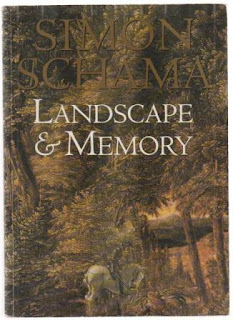
Nearly thirty years ago I discovered Simon Schama’s hefty book, Landscape and Memory (1995). (Since then the hyper-prolific Schama has become well-known for his books and television series on the history of England, on art, on eighteenth-century Holland, on the French Revolution, on the story of the Jews, etc etc.) Landscape and Memory launched me in one long stride into the line of study that has dominated my academic career: the intricate and unavoidable links between culture and nature, between trees, rocks, waters and literary expressions of individual and even national identities. As he puts it:

 Landscapes are culture before they are nature; constructs of the imagination projected onto wood and water and rock. ... [O]nce a certain idea of landscape, a myth, a vision, establishes itself in an actual place, it has a peculiar way of muddling categories, or making metaphors more real than their referents; of becoming, in fact, part of the scenery.

 In one arresting section, Schama explores the role in Polish self-consciousness of the Bialowieza forest and its iconic European bison. This is ancestral territory for Schama, and the figure of the Jewish forester looms large. Though he could find little about his direct forebears, Schama visits the region, tramping through the forests and sampling bison steak, leavening the riotous historical detail with poetic personal experience. Most intriguing for me was how the 19th-century poet Adam Mickiewicz re-imagined the forests and elevated them into Polish national icons. These central Eastern areas – Lithuania, Poland, Ukraine – are what historian Timothy Snyder calls the “bloodlands”, swept over by ravening hordes of insurgents for centuries, shifting borders, names and allegiances from year to year, riven with internecine spats and sundry rebellions. Putin is just the latest in a long series of devastating  invaders. Through it all, the forest and its bison have survived, though on an increasingly diminished scale. Ironically, they survived in part through the efforts of another invader, the Germans of 1941 – or more precisely Nazi No.2, Herman Goering, who declared Bialowieza a preserve to satisfy his own hunting proclivities.

As Schama discusses, this intersects with a German forest mythology. This one goes all the way back to the Roman historian Tacitus’ book Germania, in which he describes, not altogether disapprovingly, the leader of wild, wily, tough, almost hunter-gatherer forest tribes, Arminius. For the next two millennia, this natural, organic, self-sufficient  character would be periodically updated and refurbished to become a central mythic pillar of the German self-image through literature and art, even as agricultural and technological Germany became in reality something quite different. All this – and much more – is delivered in scintillating style, swarming with vivid historical detail and life, leavened by Schama’s characteristic dry wit. It’s historical writing at its very best.


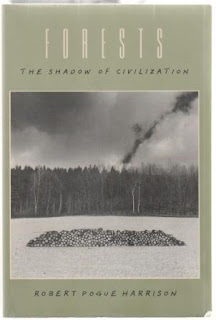
Forests occupy only a third of Landscape and Memory, but they are the whole of Robert Pogue Harrison’s book, Forests: The shadow of civilisation (1992). While overlapping a little with Schama, Harrison ranges more widely over world culture and literature, from the epic of Gilgamesh to Joseph Conrad in twentieth-century Congo, from Plato to Wordsworth. As he outlines it, the forest was long that against which civilisation set itself. From being mere clearings in the midst of forbidding and frightening wilderness, human ‘civilisation’, now technologically dominant and exponentially expanding, has all but overwhelmed that wildness. Fear remains, though, as I learned from citified students I’d take out into our own tiny forest remnants for some practical ecocritical experience. So Harrison centrally asks: “What is that antagonism, however imaginary, all about? Why does the law of civilisation define itself from the outset against the forest? For what obscure religious reasons is our humanity, in its traditional alienation from the animal kingdom, incompatible with this aboriginal environment?” He proposes, in part, that the “destructive impulse with respect to nature all too often has psychological causes that go beyond the greed for natural resources or the need to domesticate an environment”. Two chapter headings capture the book’s trajectory: “From mythic origins to deforestation”, and  “The ecology of finitude.” Once upon a time the forests might have seemed endless (as they did to the early American settlers  depicted in Annie Proulx’s epic forest novel Barkskins; axe and saw destroyed that illusion with frightening rapidity.) Deforestation and its discontents are not new: Harrison quotes Plato, lamenting the deforestation of Greece (to build warships) four centuries before Christ:

 In comparison of what then was, there are remaining only the bones of the wasted body ... all the richer and softer parts of the soil having fallen away, and the mere skeleton of the land being left.

Harrison ranges from the forest-friendly, goddess-centred ancient myths, through the forest exile of Nietzsche’s tortured philosopher-character Zarathustra, through mediaeval forest law and lore (Robin Hood’s context) to twentieth-century poets such as AR Ammons and the Italian Andrea Zanzotto. If at times Harrison seems to me to over-read, to over-psychologise his material, so that I find myself mildly disagreeing with his reading of texts I know well, such as Dante’s Inferno or Conrad’s Heart of Darkness, it’s nevertheless bewitching, challenging, educative stuff. A profound and unsettling work that leaves one in no doubt of the cultural (let alone real) importance of forests down the ages.


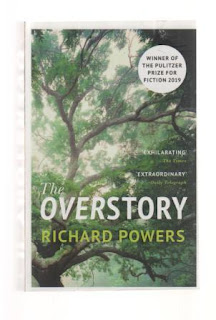
Finally, a most recent novel that actually matches up to the cover blurbs – “Exhilarating”, “Extraordinary”. American novelist Richard Powers’ The Overstory has taken the world by storm, having won that most prestigious and reliable of prizes, the Pulitzer. It has been doing the rounds of the book clubs, and has already been incorporated by university colleagues into their syllabi. Many other readers I’ve met, having read the book, have gone straight back to the beginning to start it again. It might have just a couple too many characters and strands in it; I suppose it is rather within that tradition of American novels that are as vast and sprawling as the continent, encompassing multiple plots, multiple locales and multiple ethnicities (think John dos Passos’ U.S.A., Tom Wolfe’s Time and the River, Proulx’s Accordion Crimes, Don de Lillo’s Underworld.) But who cares when the writing is this good, the invention of character so sharp and plausible, the dialogue so deft and funny, the philosophical underpinnings so unflinching and wise.

All the characters are in some way involved with trees, even when they don’t particularly think they are. They include a woman who makes it her life’s work to prove that trees communicate with each other; activists who camp in the topmost branches of a centuries-old redwood to prevent it being reduced to planks by commercial loggers; three generations of farmers who daily photograph what turns out to be America’s last chestnut tree, the rest having been blighted by invasive disease; a computer gamer. I have not encountered another writer who seems so effortlessly to capture contemporary society in both its material and techno-virtual complexity, and to expose so trenchantly its pretensions and idiocies. (The same can be said of his slimmer, but still devastating, parallel novel Bewilderment.)

Above all, with awe-inspiring research and knowledge, insight and wisdom, he illuminates the life, antiquity, complexity, vivacity, variety, beauty and vital importance of trees. I was raised in bush and mountain forest, so I needed no persuasion; but it would take an extraordinarily numb reader of any background not to feel seriously changed by this book, to have their view of trees fundamentally enhanced and illuminated. I’m far from convinced that any book or artwork, no matter how good, will radically deflect blind mass humanity from its present catastrophic course, but at least we have this one. I’ll leave you with just one representative passage, so juicy, oddball and wise, lessons so deftly refracted through character, you could take almost each sentence and meditate on its implications for a week.

 They drive from farm to farm, between last year’s blights and next year’s vanishing topsoil. He shows her extraordinary things: the spreading cambium of a sycamore that swallowed up the crossbar of an old Schwinn someone left leaning against it decades ago. Two elms that draped their arms round each other and became one tree.

            “We know so little about how trees grow. Almost nothing about how they bloom and branch and shed and heal themselves. We’ve learned a little about some of them, in isolation. But nothing is less isolated or more social than a tree. [...] Here! Look at this. Look at this!” [...]

            Her father is her water, air, earth and sun. He teaches her how to see a tree, the living sheath of cells under every square inch of bark doing things no man has yet figured out. [...] Watching the man, hard-of-hearing, hard-of-speech Patty learns that real joy consists of knowing that human wisdom counts less than the shimmer of beeches in a breeze. As certain as weather coming from the west, the things people know for sure will change. There is no knowing for a fact. The only dependable things are humility and looking.

 “Humility and looking”. Amen.

******